
Evidence first. Decisions second. Controls that fit.
A Product Security engagement should reduce uncertainty, not create another layer of security theater. The method moves from evidence to decisions, implementation, validation, and measurable change.
Collect evidence, map the product and delivery system, identify gaps, attack paths, and decision bottlenecks.
Define target architecture, controls, ownership, and a roadmap that reflects the team’s real constraints.
Integrate guardrails, tooling, security gates, workflows, and operating cadence into engineering.
Use focused assessment and authorized testing to confirm controls and expose residual risk.
Track adoption, risk debt, remediation velocity, release confidence, and leadership decisions.
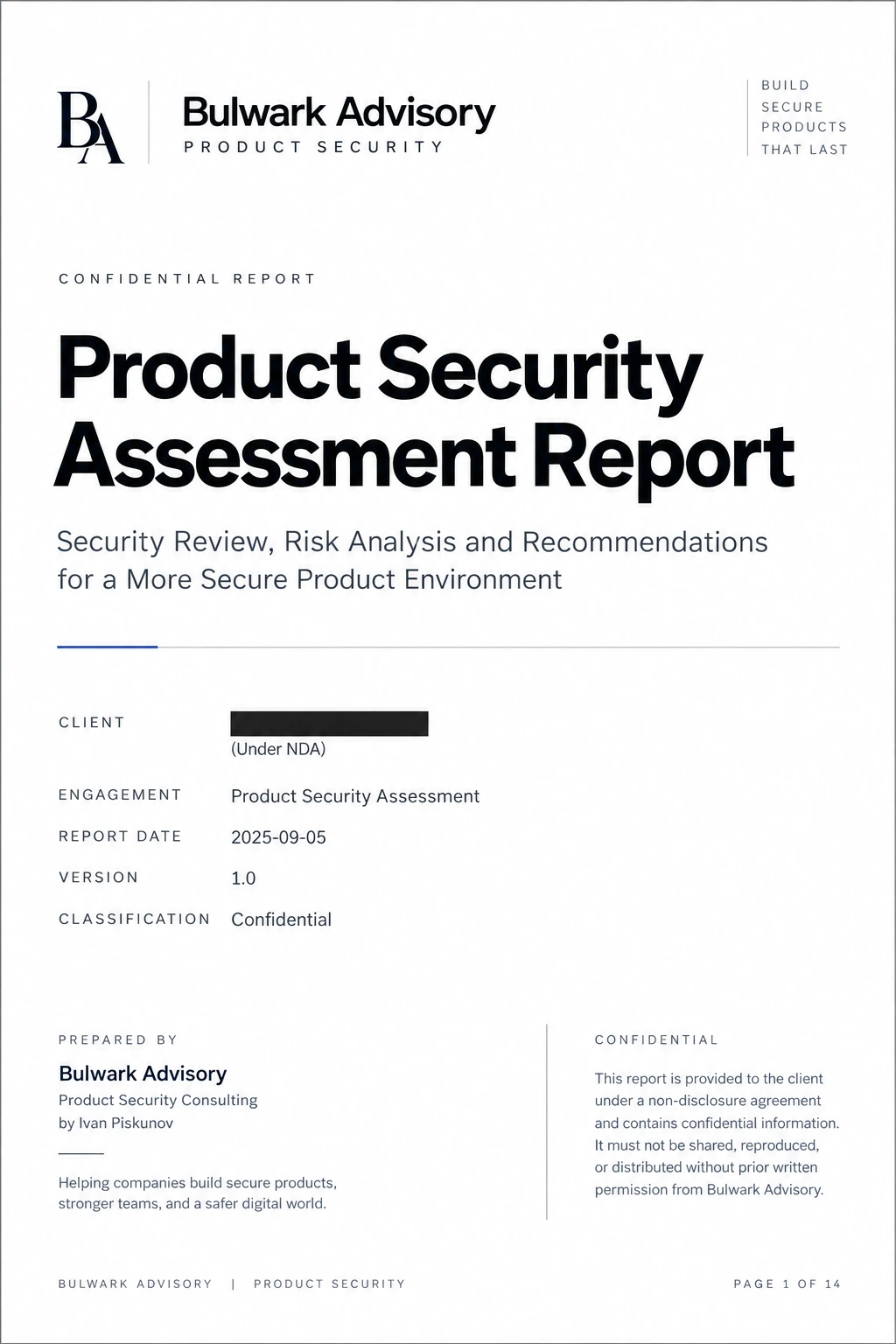
Evidence that turns into decisions.
The output is designed for action: risk-ranked findings, architecture and delivery context, ownership, remediation guidance, and a practical roadmap.
The visual is an illustrative report layout; client information is handled under the applicable engagement terms and NDA.
Use standards as scaffolding. Not as the product.
OWASP SAMM, NIST SSDF, CIS guidance, cloud benchmarks, and secure-development practices can structure the evidence. The client deliverable remains a prioritized Product Security plan tailored to the actual product.
“Aligned to a framework” and “secure enough for the product’s risk” are different questions. A useful assessment keeps both in view.
Designed for teams that cannot stop shipping.
Lean companies need decisions quickly. Discovery is scoped, evidence requests are purposeful, and output is prioritized by risk and engineering effort.
Product, architecture, business moment, constraints, and success criteria.
Evidence, technical controls, workflows, and targeted automation where useful.
Attack paths, product impact, effort, and the sequence of decisions.
Report, workshop, roadmap, reference patterns, and optional validation.
Small data systems can still create strong decisions.
For lean teams, useful Product Security analytics may begin with exports and lightweight models rather than a large platform. The method is the same: normalize evidence, add product context, prioritize, visualize, and make the update path repeatable.
DefectDojo, SAST, DAST, SCA, secrets, IaC, container or cloud findings; CSV/JSON/SARIF; budget and engineering-capacity assumptions; asset criticality and ownership data.
Explore automation service